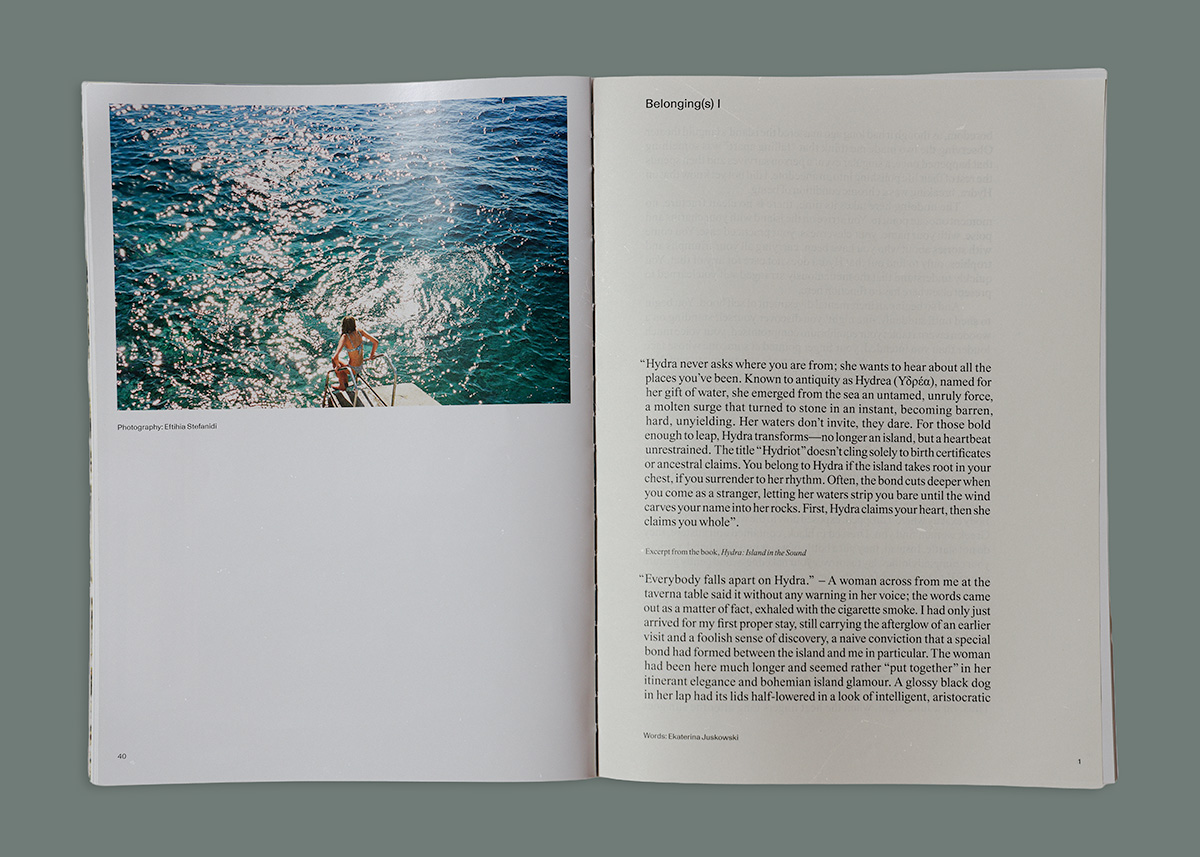
“Everybody falls apart on Hydra.”
A woman across from me at the taverna table said it without any warning in her voice; the words came out as a matter of fact, exhaled with the cigarette smoke. I had only just arrived for my first proper stay, still carrying the afterglow of an earlier visit and a foolish sense of discovery, a naive conviction that a special bond had formed between the island and me in particular. The woman had been here much longer and seemed rather “put together” in her itinerant elegance and bohemian island glamour. A glossy black dog in her lap had its lids half-lowered in a look of intelligent, aristocratic boredom, as though it had long ago mastered the island’s languid theater. Observing the two made me think that “falling apart” was something that happened once, a singular event a person survives and then spends the rest of their life polishing into an anecdote. I did not yet know that on Hydra, the breaking was a chronic condition of being.
You drift away and merge into the dancing crowd. A poet appears. “I cannot stay long in one place,” he declares. “Come away with me.”
“Are you alone?” he asks.
“No,” you say. “I’m with that man under the table.”
“Does he have cigarettes?” asks the poet.
“Of course, he does,” you reply.
You return to the table, the poet and you; your hand moves into the pocket of the sleeping body, retrieving fire without waking the source. The economy of freedom relies on borrowed forms: you borrow the sleeping man on the ground, reduced to the function of an anchor that moors you to the island, while the poet, in turn, borrows you as a scene. Neither of you believes in the promise being staged but interrupting the play would require the courage of admitting that each is, in fact, alone here. And as we continue holding onto our crutches, freedom requires the skill, without props, to stand.
Editors in Chief: Yannis Bournias & Lina Stefanou
Creative Director: Dimitris Papazoglou
Contributors: Christos Alexandropoulos, Marco Arguello, Veronica Bergamini, Leonidas Dimakopoulos, Stefan Dotter, Efi Falida, Giovanna Gatto, Tam Hall, Ekaterina Juskowski, Anastasia Kamvysi, Alex A. Kolmaniotis, Nephely Litsaki, Maria Magdalinou, Anna Manouzelou, Enez Manav, Dimitris Mantzanidis, Carole Marchall, Alkyoni Roilou, Eftihia Stefanidi, Yannis Siskos, Christina Vervitsioti.
Limited edition, 300 numbered copies
Published by NOMAS Publications.
Rododafnis7c, 14561, Athens-Greece
nomasmagazine.com